Fencing BrisbanePaling 2 of 5: when it comes down
When a dividing fence is damaged: sections 26, 28 and 32
Section 26 of Queensland’s fencing Act puts the duty to restore a dividing fence on an owner where it was damaged or destroyed by a negligent or deliberate act or omission of that owner, or of someone who entered their land with their express consent. Whatever the cause, when urgent work is needed and it is impracticable to give the usual notice first, section 28 lets an owner restore the fence without it, and section 32 lets them ask the neighbour to contribute afterwards.
General information, not legal advice. The official places to check are the Neighbourhood Disputes (Dividing Fences and Trees) Act 2011 itself and the Queensland Civil and Administrative Tribunal (QCAT), both listed at the foot of this page.
Two questions, asked separately
The Act deals with a damaged dividing fence in two separate sections, and they ask different things. One asks who caused the damage and how. The other asks only whether urgent work is needed.
Section 26: who caused it
It applies only where the damage came from a negligent or deliberate act or omission of an owner, or of a person who entered the owner’s land with the owner’s express consent. That owner must restore the fence.
Section 28: is it urgent
It applies where all or part of the fence is damaged or destroyed and urgent work is required. The cause does not affect it.
Section 26: when a neighbour caused it
“(1) This section applies if, whether before or after the commencement of this section, a dividing fence is damaged or destroyed by a negligent or deliberate act or omission of”
- “(a) an owner of land; or”
- “(b) a person who has entered the owner’s land with the express consent of the owner.”
“(2) The owner must restore the dividing fence to a reasonable standard, having regard to its state before the damage or destruction.”
Neighbourhood Disputes (Dividing Fences and Trees) Act 2011 (Qld), section 26
Every word of subsection (1) narrows it. The damage has to come from a negligent or deliberate act or omission, and from one of two people: an owner of land, or someone who entered the owner’s land with the owner’s express consent. The Queensland Government’s example of someone allowed onto a property is people working there. Someone who came onto the land without the owner’s express consent is not one of the two people section 26 names.
Where section 26 does apply, the duty is to restore the fence “to a reasonable standard, having regard to its state before the damage or destruction”. A note under the section says what the neighbour can do if the owner does not: “the adjoining owner may give the owner a notice under section 31 or carry out urgent fencing work.”
QCAT can also put a figure on it. Under section 35(1), “QCAT may, for an application in relation to fencing work for a dividing fence, decide and order any 1 or more of the following”, and one of them is “(i) the amount of compensation payable to an adjoining owner for damage or destruction to a dividing fence caused by another adjoining owner or a person mentioned in section 26(1)(b)”.
Section 28: urgent work, whatever the cause
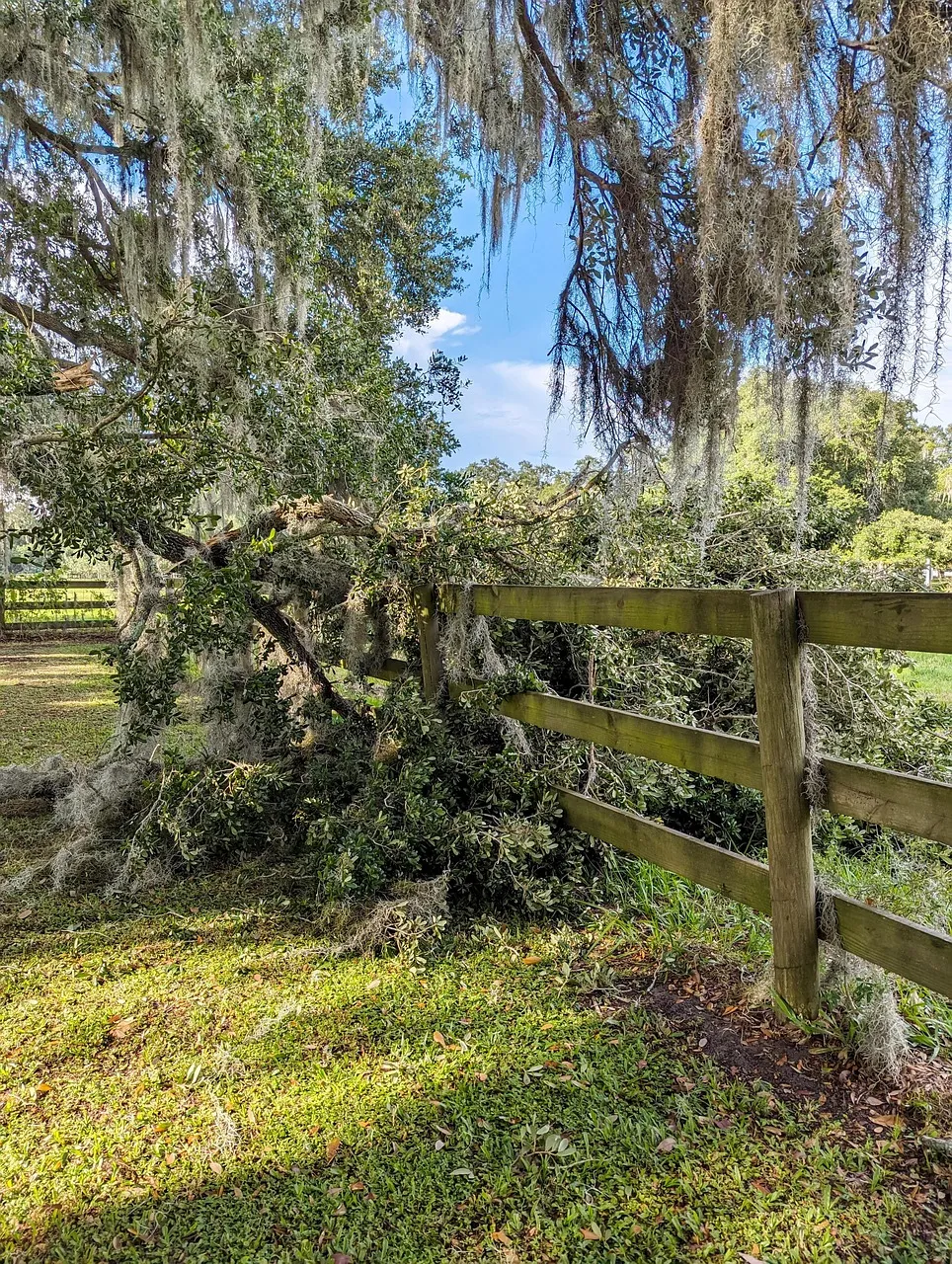
“(1) This section applies if all or part of a dividing fence is damaged or destroyed and, in the circumstances, urgent fencing work is required.”
“(2) If it is impracticable to give a notice under section 31, an owner may, without giving the notice, carry out the fencing work required to restore the dividing fence to a reasonable standard, having regard to its state before the damage or destruction.”
“(3) The cause of the damage or destruction does not affect the operation of this section.”
Neighbourhood Disputes (Dividing Fences and Trees) Act 2011 (Qld), section 28
Subsection (3) is the wide one: “The cause of the damage or destruction does not affect the operation of this section.” So damage that section 26 does not reach is within section 28 whenever urgent work is required, and so is damage a neighbour did cause, on the same condition.
Subsection (2) carries two limits. It applies where giving the ordinary section 31 notice first is impracticable, and the work it allows is the work “required to restore the dividing fence to a reasonable standard”, measured against its state before the damage. Once an ordinary section 31 notice has been given, the Act says neither owner may carry out fencing work for the fence, other than urgent fencing work, until the two have agreed about the proposed work and their contributions.
Section 32: asking for a contribution afterwards
Section 32 “applies if an owner carried out fencing work under section 28.” It lets that owner ask the neighbour to share the cost: “The owner may require the adjoining owner to contribute, under this chapter, to any reasonable cost incurred for the fencing work by giving a notice to the adjoining owner.”
“(3) The notice must be in the approved form and state the following”
- “(a) a description of the land on which the fencing work was carried out;”
- “(b) the reason urgent fencing work was required;”
- “(c) the type of fencing work carried out;”
- “(d) any cost incurred for the fencing work and a receipt for the cost.”
Neighbourhood Disputes (Dividing Fences and Trees) Act 2011 (Qld), section 32(3)
Read from the other end, that list is what the Act expects you to be able to show: why the work could not wait, and what it cost, with a receipt. The approved forms, and what happens when neighbours still cannot agree, are on QCAT’s dividing fence disputes page.
Nearby on the fence
Damage done by something fixed to the fence, such as a shade sail or a carport, has its own section, set out in attaching things to a fence. If the repair raises where the fence should stand, see when the boundary is not agreed, and if a rebuilt fence will be taller, fence heights in Brisbane sets out when Council’s building approval comes in.